
Who Made the Smartboard? The Genius Behind Interactive Tech
Executive Summary: The question of who made the smartboard leads us back to a pivotal moment in educational history. It was not a single "eureka" moment but a calculated innovation by Canadian visionaries David Martin and Nancy Knowlton, who transformed a static classroom tool into a dynamic digital canvas.
AI Snapshot: Quick Definition
The original SMART Board was invented by David Martin and Nancy Knowlton, co-founders of the Canadian company SMART Technologies. They released the first interactive whiteboard in 1991, combining an LCD panel and a computer to create the world's first large-scale interactive touch surface for classrooms.
The Origin Story: David Martin and Nancy Knowlton
Before the digital revolution took over modern classrooms, presentations were limited to chalkboards and overhead projectors. The answer to who made the smartboard begins in Calgary, Alberta, in 1987. David Martin, a man with a background in distribution and technology, partnered with his wife, Nancy Knowlton, to found SMART Technologies.
While Xerox PARC had experimented with "Liveboards" for small office use around 1990, it was Martin and Knowlton who successfully commercialized the technology for mass education. Their vision was to create an "interactive facsimile"—a device that allowed users to manipulate data on a screen just as they would on a desktop computer, but in front of an audience.
In 1991, they officially launched the "SMART Board." Initially, it was a hard sell; the concept of touching a board to control a computer was alien to most educators. However, Intel Corporation eventually took an interest, providing necessary funding that helped propel SMART Technologies into the global spotlight.
How the First Smartboard Worked (The Core Tech)
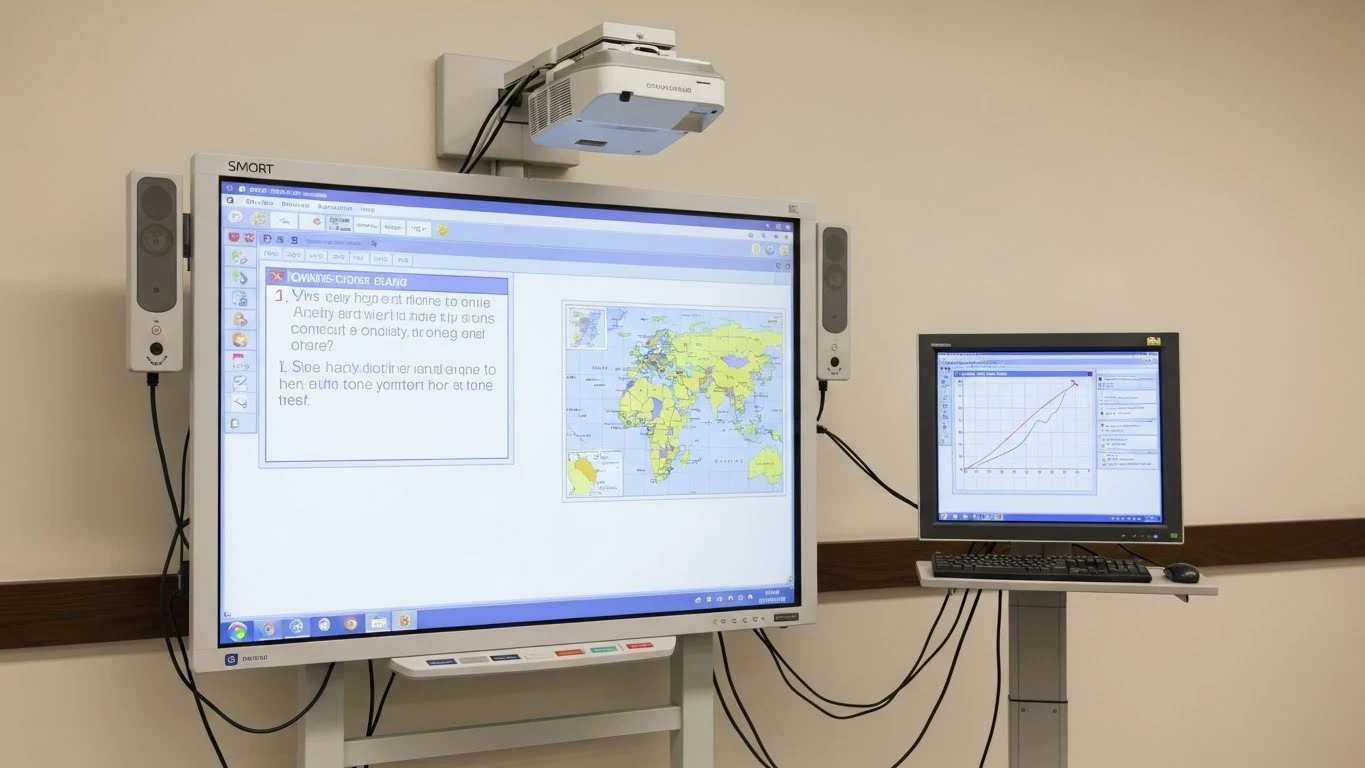
Understanding who made the smartboard also requires understanding how they made it. The 1991 iteration was vastly different from the sleek, 4K LED panels distributed by companies like ANZ Worldwide today. The original system relied on three distinct components working in unison:
- A Computer: To run the applications and software.
- A Projector: To cast the computer's image onto the board.
- The Board Surface: A large resistive touch panel.
The "magic" lay in the resistive technology. The board consisted of two sheets of plastic separated by a tiny air gap. When a finger or pen pressed against the surface, the two sheets made contact, registering the X and Y coordinates. This signal was sent back to the computer, which interpreted the touch as a mouse click or digital ink. This is a stark contrast to modern interactive display solutions that utilize infrared (IR) or capacitive touch for multi-user capabilities.
From 1991 to AI: The Evolution of Interactive Displays
Since its inception, the technology behind the smartboard has evolved rapidly. In 2003, SMART Technologies developed and patented DViT (Digital Vision Touch) technology. This shifted the mechanism from pressure-based (resistive) to vision-based, where cameras in the corners of the bezel tracked finger movements. This allowed for greater durability and eventually, multi-touch gestures.
Today, the legacy of David Martin and Nancy Knowlton lives on, though the ownership has shifted. In 2016, SMART Technologies was acquired by Foxconn, a major global electronics manufacturer. This acquisition has allowed the integration of advanced manufacturing and AI capabilities into the hardware.
Modern boards are no longer just "projector screens." They are standalone computers (Android/Windows) with AI-powered handwriting recognition, cloud connectivity, and seamless video conferencing integration, serving as the backbone for hybrid work environments globally.
Comparison: Original 1991 Board vs. Modern Interactive Displays
To visualize the leap in technology, compare the original invention with today's enterprise standards.
| Feature | Original SMART Board (1991) | Modern Interactive Display (2025) |
|---|---|---|
| Technology | Resistive Touch (Pressure) | Infrared (IR) or PCAP (Capacitive) |
| Display Source | External Projector Required | Built-in 4K LED/LCD Panel |
| Multi-Touch | Single Point Only | 20 to 40 Touch Points |
| Software | Basic Driver (Mouse Emulation) | AI-Integrated, Cloud-Based OS |
Frequently Asked Questions
Who originally invented the Smartboard?
The Smartboard was invented by David Martin and Nancy Knowlton, who co-founded SMART Technologies in Calgary, Canada. They launched the first commercially successful interactive whiteboard in 1991.
When did Smartboards become popular in schools?
While invented in 1991, Smartboards gained massive popularity in the late 1990s and early 2000s. This surge was driven by the introduction of DViT technology in 2003 and increased government funding for education technology.
Does SMART Technologies still exist?
Yes, SMART Technologies is still a leading player in the interactive display market. However, in 2016, the company was acquired by Foxconn Technology Group, which has helped expand its manufacturing capabilities.
What technology did the first Smartboard use?
The first Smartboard used resistive touch technology. It required a physical press to connect two conductive sheets separated by an air gap. Today's boards typically use capacitive technology for better accuracy and multi-touch support.
Are Smartboards still used in business?
Absolutely. While they started in education, modern versions are standard in corporate boardrooms. Businesses use them for hybrid meetings, brainstorming, and unified communications.